
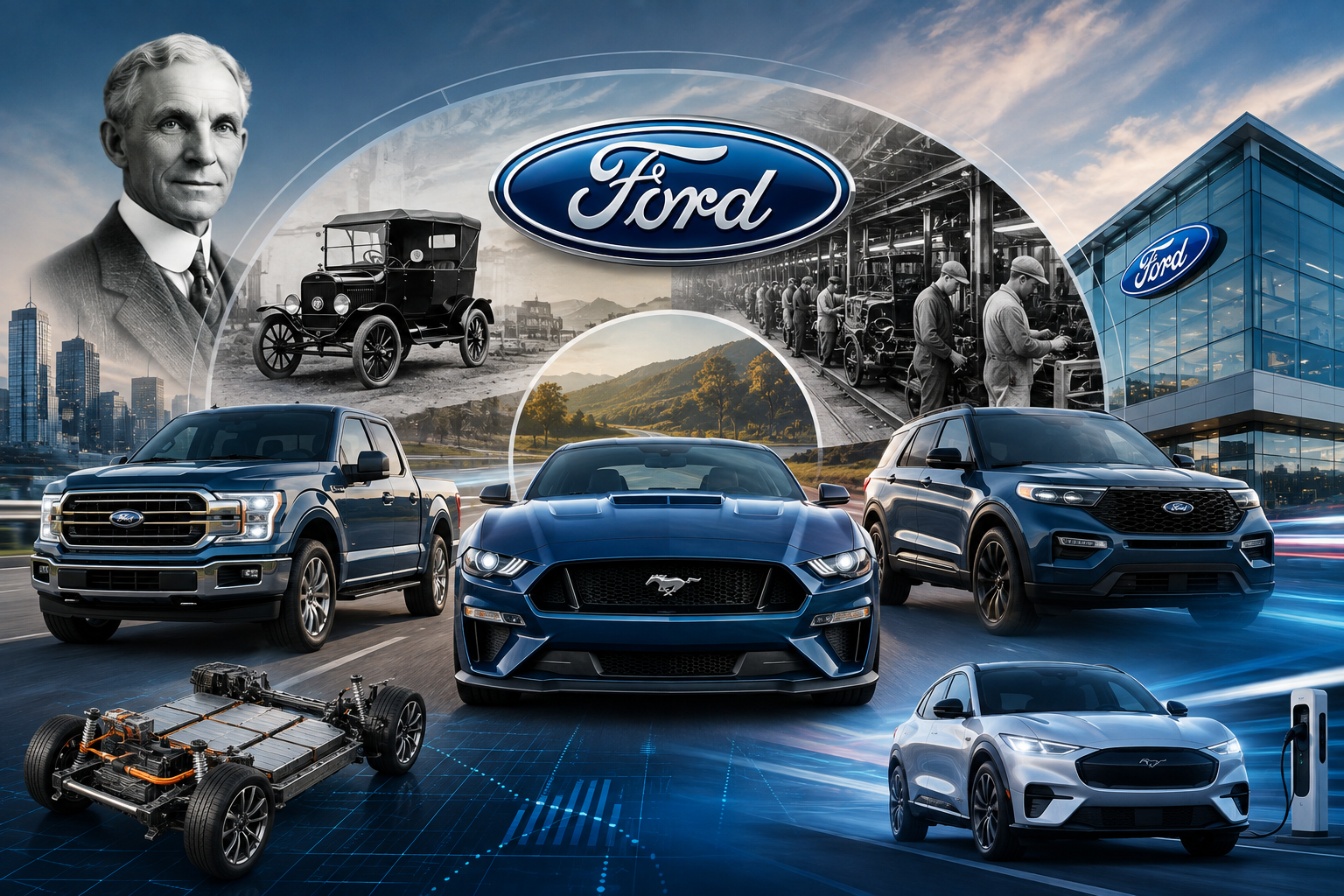
Few automotive brands have influenced the modern automobile industry as profoundly as Ford. More than a century after its creation, the Ford name remains associated with innovation, mass production, powerful vehicles, and the idea that mobility should be accessible to ordinary people. From the legendary Model T to the Mustang, F-Series trucks, SUVs, commercial vehicles, and today’s electrified and software-driven vehicles, Ford’s story is one of continuous transformation.
Ford Motor Company was incorporated in 1903 by Henry Ford and a group of investors. At the time, automobiles were still largely considered expensive and relatively impractical machines. Ford’s ambition was different. He wanted to build vehicles that were durable, practical, reliable, and affordable enough for a much wider population. That vision would eventually change not only the automobile business but also manufacturing itself.
The Vision of Henry Ford
Henry Ford’s interest in mechanics began at an early age. He experimented with machines and engines before eventually working as an engineer in Detroit. His fascination with automobiles grew during a period when the industry was still in its infancy.
Ford did not succeed immediately. Before establishing Ford Motor Company, he experienced setbacks in earlier automobile ventures. His determination to continue experimenting eventually led to the creation of Ford Motor Company in 1903. The company initially operated with limited capital, but its founders had a clear objective: develop automobiles that could reach a much larger market.
This willingness to continue after failure became an important part of Ford’s story.
The company was not simply trying to manufacture another automobile. It was attempting to rethink the economics of personal transportation.
The Model T Revolution
The defining moment came in 1908 when Ford introduced the Model T.
The Model T was designed to be practical, durable, relatively easy to operate, and suitable for the roads of its time. More importantly, Ford developed a manufacturing system that allowed the vehicle to be produced on an enormous scale.
Ford’s official history records that approximately 15 million Model Ts were sold before production ended in 1927. The vehicle helped make personal transportation accessible to millions of people and became one of the most influential automobiles in history.
The Model T was not simply successful because of its engineering. Its success came from combining product design with manufacturing innovation.
That combination would become one of Ford’s defining characteristics.
The Moving Assembly Line
Perhaps Ford’s most important contribution to modern industry was its development and implementation of the moving assembly line for automobile production.
In 1913, Ford introduced the integrated moving assembly line at its Highland Park facility. The process dramatically reduced the amount of time required to assemble a Model T. Ford’s historical records state that chassis assembly time eventually fell from about 12.5 hours to approximately 1.5 hours.
The impact was enormous.
Faster manufacturing meant Ford could produce more vehicles. Greater production volumes helped reduce costs, allowing the company to make automobiles more affordable.
The assembly line therefore created a powerful relationship between manufacturing efficiency and consumer accessibility.
Ford had effectively demonstrated that innovation did not have to mean inventing an entirely new product. Sometimes, the biggest innovation comes from finding a better way to produce and distribute an existing product.
The influence of this idea extended far beyond automobiles. Mass-production principles inspired manufacturing industries around the world.
More Than a Car Company
As Ford expanded, it became much more than a manufacturer of passenger cars.
The company entered trucks, tractors, aircraft production, military manufacturing, and other industrial activities. Ford’s River Rouge Complex became one of the world’s largest integrated manufacturing facilities and incorporated multiple industrial operations.
During World War II, Ford redirected significant manufacturing capacity toward military production. Ford facilities produced vehicles, aircraft engines, tanks, and thousands of B-24 Liberator bombers.
This period demonstrated the scale and flexibility of Ford’s manufacturing capabilities.
The company had developed an industrial system capable of adapting to enormous changes in demand and national priorities.
The Ford Family Legacy
Ford’s history is also closely connected to several generations of the Ford family.
Henry Ford’s son, Edsel Ford, became president of the company in 1919. Edsel brought a strong interest in design and aesthetics, helping introduce another dimension to Ford’s identity.
Later, Henry Ford II played a major role in rebuilding and modernising the company after World War II. When he became president in 1945, Ford faced significant organisational challenges. With the help of a group of former U.S. Army Air Force officers known as the “Whiz Kids,” Ford adopted more modern management practices and prepared itself for the increasingly competitive post-war automobile industry.
This period illustrated another important lesson from Ford’s story: even established companies must continuously reinvent themselves.
The Birth of the F-Series
Ford’s connection with trucks became one of the most important chapters in its brand history.
In 1948, Ford introduced the F-Series line of trucks, moving toward purpose-built truck platforms rather than simply adapting passenger-car platforms. Over time, the F-Series became one of the most recognisable names in the pickup-truck market.
The F-Series represents a major part of Ford’s brand identity because it combines utility, durability, capability, and everyday practicality.
For generations of customers, Ford trucks have been associated with farms, construction sites, businesses, families, outdoor activities, and demanding work environments.
The success of the F-Series also demonstrates the importance of understanding a specific customer need.
Rather than trying to make one vehicle suitable for everyone, Ford developed products around different lifestyles and use cases.
The Mustang Becomes a Cultural Icon
In 1964, Ford introduced the Mustang, a vehicle that would become far more than another automobile.
The Mustang helped establish a new category of sporty, relatively accessible cars and quickly developed a strong cultural identity.
Its long history has made the Mustang one of the most recognisable names in the automotive world.
The Mustang demonstrates how a product can become a symbol. Customers do not always buy automobiles only because of transportation needs. They may buy them because of design, performance, freedom, lifestyle, nostalgia, or personal identity.
Ford has repeatedly succeeded when it has understood this emotional side of automobile ownership.
Learning From Failure
Ford’s history has not been a story of uninterrupted success.
The company has experienced product failures, changing market conditions, economic downturns, intense competition, manufacturing challenges, and strategic mistakes.
One famous example was the Edsel, introduced in 1957. The vehicle failed to achieve the commercial success Ford had expected.
For a brand story, these moments are important because they demonstrate that even some of the world’s most recognised companies can make the wrong decisions.
The difference is what happens next.
Ford’s long history has involved repeatedly examining market changes, customer expectations, technology, and competition and then adapting its products and strategy.
Failure therefore became part of the company’s learning process.
Ford and the Global Automobile Market
Ford’s expansion was never limited to the United States.
The company began international expansion very early. Ford opened an overseas branch in Paris in 1908, followed by expansion into markets including Britain, Australia, Argentina, Brazil, and other countries over subsequent decades.
This international presence helped transform Ford from an American manufacturer into a global automotive brand.
Operating internationally also required Ford to understand different customers, regulations, roads, economic conditions, cultures, and transportation needs.
That experience helped establish the global identity associated with the Blue Oval.
The Power of the Blue Oval
The Ford logo has become one of the most recognisable symbols in the automobile industry.
The company’s scripted trademark emerged in the early 20th century, while the iconic oval appeared on a Ford vehicle with the 1927 Model A.
The Blue Oval represents more than corporate identity.
For generations, it has represented a promise associated with Ford vehicles: practical engineering, automotive heritage, capability, and mass-market mobility.
A strong logo becomes powerful when it is supported by decades of customer experiences.
Ford’s Brand Philosophy
At the heart of Ford’s story is a relatively simple idea: create products that are useful to real people.
That philosophy has taken different forms over the years.
For the Model T, it meant affordable personal transportation.
For the F-Series, it meant capable and dependable trucks.
For the Mustang, it meant accessible performance and personality.
For commercial customers, it means vehicles and services designed around business needs.
For modern customers, it increasingly includes connected technology, digital experiences, electrification, and advanced driver-assistance features.
The products may change, but the fundamental focus on customer needs remains.
Ford Enters the Digital Era
The automobile industry is now undergoing another major transformation.
Cars are increasingly becoming software-enabled products. Connectivity, digital interfaces, driver-assistance technology, over-the-air updates, electrification, and data are changing how vehicles are developed and experienced.
Ford is responding by investing in new vehicle platforms, software, manufacturing processes, and electrified products.
In April 2026, Ford announced a new Product Creation and Industrialization organisation designed to bring together advanced technology and global industrial teams. The company said the initiative would support a major product and technology rollout under its Ford+ plan.
Ford has also been developing a Universal Electric Vehicle platform intended to improve efficiency, affordability, digital experiences, and manufacturing processes.
This direction is significant because Ford’s history has always been connected to manufacturing innovation.
More than a century ago, the company transformed automobile production with the moving assembly line.
Today, the company is attempting to apply a similar mindset to the development and manufacturing of next-generation vehicles.
Electrification and the Next Chapter
The shift toward electric and electrified vehicles represents one of the biggest changes in the automotive industry since the invention of the automobile.
Ford’s future strategy includes a combination of hybrids, extended-range electric vehicles, and fully electric vehicles. The company has stated that nearly 90 percent of its global nameplates will offer electrified powertrains by 2030.
This transition is not simply about replacing an internal-combustion engine with a battery.
Electric vehicles require different manufacturing processes, battery technologies, software systems, electronic architectures, charging ecosystems, and customer experiences.
Ford’s challenge is to bring its traditional strengths in trucks, SUVs, commercial vehicles, and performance cars into this new era.
That means the future of Ford will depend on how effectively it can combine heritage with innovation.
The Future of Ford
The automotive industry is becoming more competitive and technology-driven than ever before.
New electric vehicle companies have entered the market. Traditional manufacturers are developing software capabilities. Technology companies are becoming increasingly involved in mobility. Customers expect connected experiences and continuous improvements.
Ford therefore faces a new kind of competition.
The company is no longer competing only on engine performance, vehicle design, price, or manufacturing quality. It is also competing on software, batteries, digital experiences, connectivity, charging, autonomous-driving technology, and user experience.
Ford’s response is rooted in its historical willingness to change.
The company that once transformed automobile production through mass manufacturing is now working to modernise how vehicles are designed, built, powered, and updated.
Why the Ford Story Still Matters
Ford’s story remains relevant because it is ultimately a story about solving a problem at scale.
Henry Ford saw an automobile industry that primarily served a limited market and imagined a world in which ordinary people could own cars.
The Model T became the product.
The assembly line became the system.
The Ford brand became the identity.
And the result changed society.
Today, the problems facing the automotive industry are different. Customers want cleaner transportation, better digital experiences, greater safety, more efficiency, and increasingly advanced technology.
Ford’s challenge is once again to make major technological changes practical and accessible to a large market.
That is what makes the company’s future particularly interesting.
Conclusion
Ford is more than an automobile manufacturer. It is a brand built around more than a century of engineering, manufacturing, design, competition, failure, adaptation, and innovation.
From Henry Ford’s early experiments to the Model T, from the moving assembly line to the F-Series, from the Mustang to today’s connected and electrified vehicles, Ford has repeatedly changed with the automobile industry.
Its greatest contribution may not be any single vehicle.
It may be the idea that innovation becomes truly powerful when it reaches millions of people.
The Model T demonstrated that concept more than a century ago. Ford’s manufacturing revolution made personal transportation accessible to a mass market and established a blueprint for modern industrial production.
Now the company is entering another defining period.
Electric powertrains, software, connected vehicles, advanced driver assistance, new manufacturing technologies, and changing customer expectations are reshaping the automobile industry.
The next chapter of Ford’s story will be determined by how successfully it combines its extraordinary heritage with the demands of a new automotive era.
For a company that has spent more than 120 years reinventing mobility, the journey is far from over.
The Blue Oval continues to move forward, carrying with it a legacy built on one enduring idea: innovation matters most when it improves the way people live, work, and move.